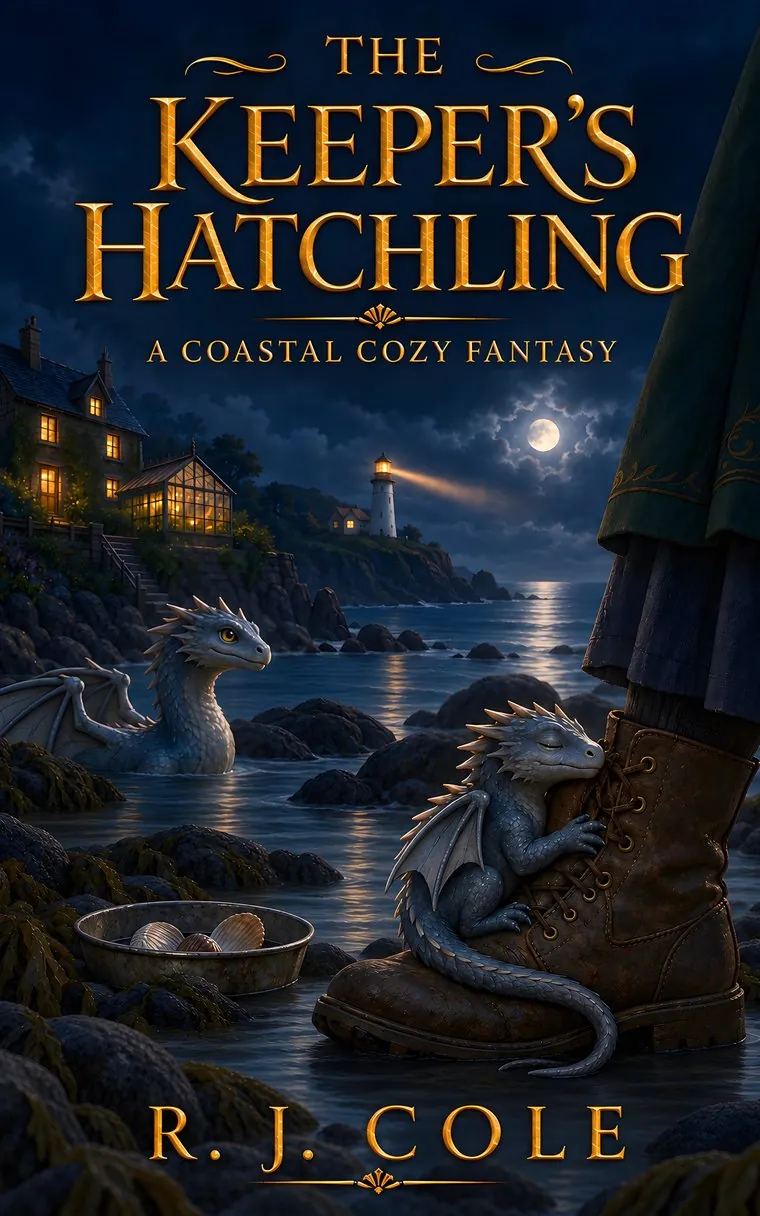
The spring low fell at a quarter past four, and Nora was on the shingle by half past three with the rope over her shoulder.
Tommy Ford was there before her. He sat on the iron ring Edith had set into the rock below the path, as if he could keep it warm for her, and he stood up when he saw her coming.
“Ada says I am to hold it like it owes me money,” he said.
“Ada is right.”
Nora shook the coil loose and fed one end through the ring. The rope was the same tarred line Ada had tied to the skiff last summer, gone dark and supple with use. She knotted it at her waist, tested the knot with her full weight against the ring, and handed Tommy the slack.
He took it in both gloved hands and set his boots in the wet sand without being told. He had done this through the whole winter. He no longer asked what was in the cave. He asked about the tide instead, which Nora took as a sign of good sense.
“Ebbing still,” he said, watching the water.
“Another twenty minutes.”
The evening was cold and very still. The first calm days of January had laid the cove out flat and pale gold, and the rocks below the east point stood up out of the water like the backs of sleeping animals. Oystercatchers worked the tide line, piping at each other. The weed on the lower stones smelled of iodine and cold salt. Across the water the lighthouse stood white against a sky that was already thinking about dusk, its lamp not yet lit.
Nora had come down at every spring low since the end of summer. Twice a month, at the bottom of the tide, when the crevice opened wide enough to take a woman carrying a lamp. She kept the dates in the back of the keeper’s log, and beside each date she wrote what she found.
Unchanged.
Unchanged.
She had written it nine times. It had stopped feeling like a disappointment somewhere around the fifth. A living egg in a cold cave was allowed to be patient. Edith had waited thirty-four years in that cottage for less.
The water drew back from the foot of the crevice. Nora lit the lamp, closed it inside its oilskin bag, and held it above her head.
“Two tugs is five minutes,” Tommy said.
“And two again?”
“Two again is I haul you out whether you like it or not.”
“Good,” Nora said, and walked into the sea.
The cold took her at the knees, then at the waist, until she no longer felt it as cold. She had not flinched at it since November. The rock closed in on either side. She turned her shoulder to the barnacles and let the current draw her through, the rope paying out behind her, the lamp swinging its small light across wet stone.
The passage opened. The chamber took her in.
She knew it by now as well as she knew the cottage in the dark, the vault of the ceiling lost in shadow and the walls worn smooth as old leather. The seven cradles stood in their curve along the wall, empty and pale with salt, and the eighth set apart in its recess behind the worn ridge of stone.
Cove was there already.
That was not unusual. Cove lived in the restored pool and the open cove now, coming and going through the sluice as it pleased, but at the spring lows it was always in the chamber before her. Nora had stopped wondering how it knew the hour. It knew the tide. The hour was a human afterthought.
What was unusual was that Cove was working.
Nora stopped in the water with the lamp held high and did not move.
A strand of fresh wrack hung from Cove’s jaw, green and dripping, still slick from the channel. Cove swam the last length to the recess with its head up, laid the weed along the edge of the cradle, and pressed it down with the flat of its nose. It turned and went back out along the wall toward the passage, toward the dark water where the sea came in, and came back with more.
The cradle had changed.
Nora waded closer, slowly, keeping to the far side of the chamber so that she would not cross Cove’s path. The four nesting stones she had carried down last summer no longer sat beside the egg. Cove had moved them. They stood now in a ring around it, hollows turned inward. In the gaps between them Cove had packed shell grit, fine and grey, and over it a thin new layer of salt scraped from the chamber walls. The salt glowed in the lamplight. It made a white ring on the dark stone, clean and unbroken, with the egg at its centre.
Nora had seen nest-making before. In ewes, a day or two out, pawing straw into a corner of the pen. In a vixen under a shed in the marsh wards, carrying dead grass in her mouth one stalk at a time. In a hen at Dunwold who had pulled the feathers from her own breast to line a box. It looked different in every creature that did it. It always meant the same thing.
Something was coming.
She looked at the egg.
All winter it had been grey-blue and smooth, the colour of Cove’s scales, with the faint light of the cave caught in its surface. It was not that colour now. It had grown, too. Last summer it had been the size of her fist, and now it was bigger than both her fists together. The shell had gone cloudy. It had the milky, frosted look of glass that has spent a long time in the sea, the kind children found on the tide line and carried home in their pockets. When the lamplight touched it, the light did not slide off. It went a little way in.
Cove came back with more weed. It laid the strand along the ring, pressed it down, and this time it did not go out again. It lowered itself into the water beside the cradle and lay with its chin on the stone and its eyes on the egg, while its spines moved in a slow, even wave from neck to tail.
Then it turned its head and looked at Nora.
She had learned, over three seasons, not to make a creature’s look mean more than it did. But it had been a long time since Cove had looked at her as if she were the one who needed to understand something.
“I see it,” Nora said quietly.
She waded the last few feet and stood at the edge of the recess. Cove did not move to block her. It watched her hand come down and did not lift its head from the stone.
The shell was not cold.
That was the first thing. Every other time, the egg had held the cave’s cold, deeper than the water, the cold of stone that had never seen daylight. Now, under the clouded surface, it was cool rather than cold. Cool like a stone in the early morning, before the sun has reached it. It was not warm yet.
Beneath her palm the slow movement came and went with the water, as it always had. It was stronger. She could not have said by how much. Only that she did not have to wait for it.
Nora kept her hand there for the length of three breaths. Then she took it away, because the egg was not hers to hold.
Two tugs ran down the rope.
She checked the water against the barnacle line on the wall. The tide had paused at the bottom. Five minutes, and Tommy had read it right.
She would have liked an hour. She would have liked to sit on the ledge and watch Cove watch the egg until the lamp burned out. Instead she made herself look at the chamber the way she would look at any nest she meant to leave alone. The ring was sound and the weed was fresh. The water in the recess moved clean over the grit and out again, with nothing caught in it that should not be there. There was nothing for her to do.
That was the hardest part of the work, and the part nobody wrote down.
“I will come back,” she told Cove.
Cove blinked once and laid its head back on the stone.
The passage was colder going out. The light at the mouth of the crevice had gone from gold to copper while she was inside, and when she came out into it the evening air found every wet inch of her. Tommy hauled the last of the slack in, hand over hand, and did not let go of the rope until she was standing on dry stone.
“Three minutes to the turn.”
“You read it well.”
He coiled the rope over his elbow the way Ada had taught him, and watched her untie the knot at her waist. Her fingers were slow with cold. He waited without offering to help, which was another thing Ada had taught him.
“Is it the same?” he asked.
Nora took the keeper’s log from inside her oilskin and opened it to the back page. Under the ninth entry, under the ninth unchanged, she wrote the date with a pencil gone soft in the damp.
Shell clouded. Not cold. Cove building a nest.
Tommy read it over her arm. He read it twice.
“Does that mean it is coming?”
“It means Cove thinks so.”
“Is Cove usually right?”
“About the sea, I have never known it to be wrong.”
He looked out at the cove, at the dark line of the crevice where the water was already beginning to come back. His face had the look it had worn on the harbour wall last summer, when he told her about the second boat. The look of a boy holding something too large for his hands and deciding to hold it anyway.
“I will not say anything.”
“I know.”
“Not even to Da.”
“You may tell your father. Your father will not tell anyone else.”
Tommy considered this and found it true. He handed her the coiled rope and went off up the lower path at a run, toward the harbour and his supper, without looking back.
Nora walked up slowly. Her boots squelched. Her hands had gone white and wrinkled with cold. The cottage stood at the top of the rise with its new roof and its open back window, smoke going straight up from the chimney into the still air. The gate stood open, the way she had left it.
The greenhouse door was open too. Through it she could see the rose against the far wall, bare still, but with new shoots coming red along the old cane. Bramble was not among them. Bramble was on the cottage windowsill, asleep in a patch of the last sun, with something stolen tucked under its chin. It looked like one of Nora’s hairpins.
She left it the hairpin.
There was a letter on the floor inside the door.
It had been pushed under while she was in the cave, and it lay face down on the flagstones with a small black figure standing on it. Mote had come out of the inkwell to receive it. It stood on the exact centre of the envelope with both front feet planted, as if anyone who wanted the letter would have to go through it first.
“Thank you,” Nora said. “I can take it from here.”
Mote considered her wet sleeves and the letter, then her sleeves again. It stepped off onto the flagstones with an air of having made a large concession, and left one small black print on the corner of the envelope as a receipt.
Nora turned the letter over.
The registry seal. The protected-sites office, Harrowmere. She had been waiting for this letter, or one like it, since the autumn. Her appointment had been extended under the condition of a full habitat assessment, and an assessment meant an assessor, and an assessor meant someone from Harrowmere standing in her yard with a notebook. She had expected a clerk. A young man with clean boots, most likely, who had never stood in seawater in his life. Her own letter asking to be taken off the rotating list, the one she had sealed in green wax, had been answered in four lines that read as if he had written them.
She broke the seal at the kitchen table and read it standing up, dripping onto the boards.
The Keeper-Assessor would attend the Driftwood Dragon Sanctuary in person to conduct the habitat assessment, arriving by the coastal cart from Harrowmere on Friday. The assessment would be carried out under sealed-site protocol. No cave location would be entered into any record. The keeper’s authority over daily operations was confirmed. And should the egg reported in the keeper’s file prove viable within the term of the assessment, the Keeper-Assessor would remain to supervise the hatching in accordance with registry practice.
Supervise.
Nora read the word again. Then she read the signature.
A. Whitlock, Keeper-Assessor.
She knew the name, though it took her a moment to place it. She crossed the kitchen to the shelf beside the hearth and took down the thin grey booklet she had not opened since her first week.
The registry pamphlet. The one every contract keeper was issued and nobody kept. Its cover had curled in the damp and gone soft at the corners. The title was printed in small plain capitals: Notes on the Keeping of Dragons. And beneath the title, in smaller capitals still: A. Whitlock, Keeper-Assessor to the Registry.
Nora opened it to the page she remembered.
Housing. Temperature. Signs of distress. Common ailments. Forty pages of careful advice about dragons that lived in barns, gardens, chimneys and walls. And on page thirty-one, at the bottom, in type so small she had needed the window light to read it on her second morning in Port Selby, a single footnote.
Tide dragons. Rare. Coastal. Specialist knowledge required.
That was all. She had read it at the dry sink with a dragon at the window that would not eat and a saucer of untouched mackerel on the floor. There had been nowhere in the world to find the specialist knowledge it promised. Edith had found it for her instead. Edith had written it on a scrap of paper and pushed it behind a loose stone, because Edith had known nobody else was going to.
Nora went to the drawer of the writing desk and took out the scrap. She kept it there now, flat between two clean sheets, where the damp could not reach it.
Feed cockles at low tide. Do not try to hold it.
She laid it on the open pamphlet, over the footnote.
The paper was almost exactly the same size. Edith’s small, hard handwriting covered the printed line completely, and when Nora took her hand away, the footnote was gone.