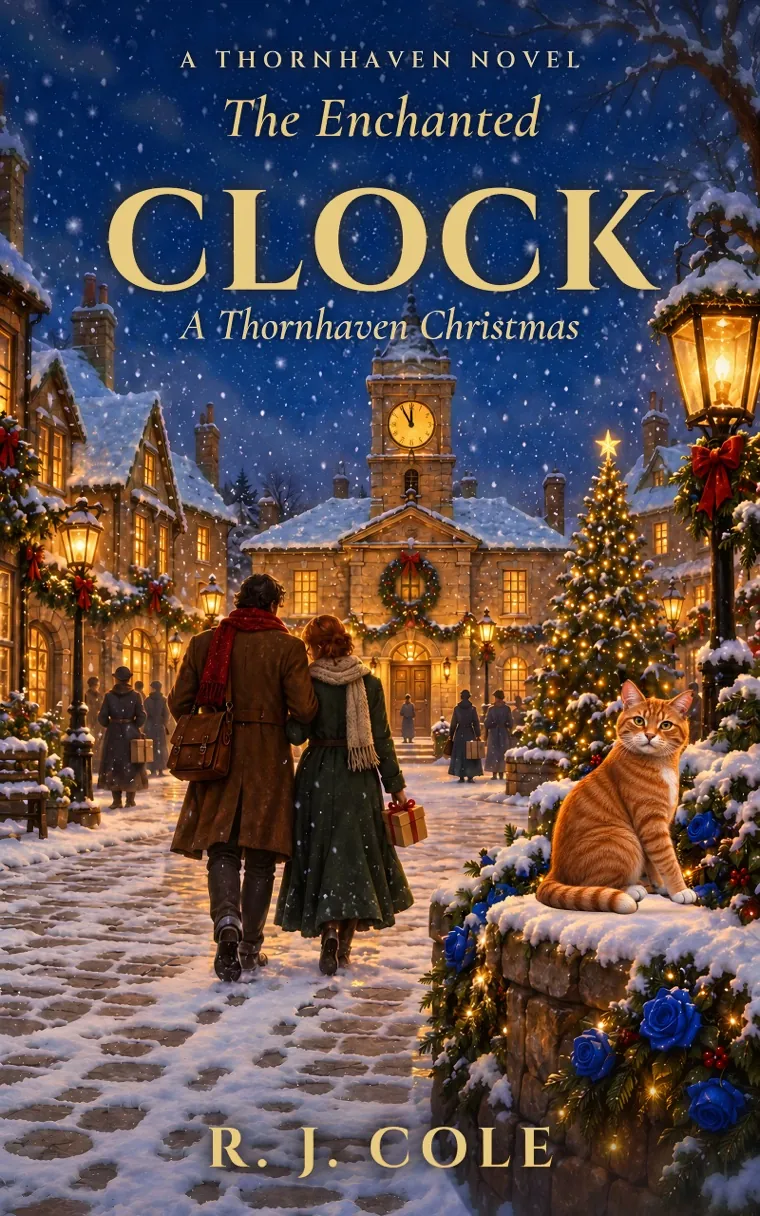
The snow came to Thornhaven nine days before Christmas, on a Tuesday. Cael Ashford had lived in the village long enough to know that this was the day Thornhaven saved for things that mattered.
It began while he was on his knees in Mrs. Pottinger’s kitchen with his head halfway inside her stove. One moment the window over the sink showed the ordinary gray of a December afternoon, and the next it was full of flakes, large and slow and entirely unhurried, drifting past the glass as if they had been waiting all autumn for permission and had finally received it.
“There,” Mrs. Pottinger said, with the grim satisfaction of a woman proved right. “I told you.”
“You told me it would snow by Friday.”
“I told you it would snow and the pot would sulk. Look at it.”
Cael looked at it. The soup pot sat on the back burner where it had sat for the last forty minutes: squat, black, enchanted, and cold. Mrs. Pottinger had put a ham bone and a quantity of split peas in it at noon. The pot had declined to simmer them. It had not boiled over, or flung its lid across the room, or done any of the things it had once done in the dark days before Cael had learned its temper. It had simply sat there with its water perfectly still and its enchantment humming at a pitch that, to a trained ear, sounded a great deal like a sigh.
He took his head out of the stove.
“It’s not the stove,” he said. “The stove’s fine.”
“I know the stove’s fine. It’s the pot. It’s always the pot.”
He knew that too. He had known it since he first opened Aldric’s repair ledger and found, under Pottinger, soup pot, an entry in the old man’s steady early hand: Dislikes weather. Reassure. Beneath it, forty years of the same instruction, a little shakier each decade. Reassure. Reassure. Reassure.
Cael had thought, the first time he read it, that it was a joke. He had since come to understand it as a maintenance procedure.
He lifted the pot off the burner, which it permitted, and set it on the table, where he could see the base. The resonance crystal set into the iron was clean and seated and glowing a faint, resentful amber. He laid two fingers against the metal beside it. Cold iron. Under the cold, the enchantment, running true and steady and wanting, plainly, not to be asked to do anything today.
“You know what it wants,” Mrs. Pottinger said.
“I do.”
“Well, don’t make me watch.”
She went to the window and made a great show of looking at the snow. Cael sat down at her kitchen table with the pot in front of him and his bad knee stretched out beneath it, the cold already settling into the joint as it did every winter, a dull, familiar ache like a debt coming due. He took out his calibration wand, touched it to the crystal, and adjusted the warming threshold three degrees down, so the pot would notice its own heat sooner and trust it.
Then, because the ledger said so, he talked to it.
He kept it simple. He said that it had been a long autumn and a wet one. He said the snow was only snow and would be gone by spring. He said that there were split peas in it, and a proper ham bone, and that Mrs. Pottinger had been making this soup on the first snowy day of every winter for longer than Cael had been alive, and that it would be a shame to disappoint her.
The crystal brightened. The iron warmed under his fingers. Somewhere inside the pot, faint as breath, the water began to move.
“There,” Cael said.
Mrs. Pottinger turned from the window. She did not thank him. She had never once thanked him, not in all the time he had been coming here, and he had worked out long ago that this was because thanking the enchanter would have meant admitting that the pot had a problem, and the pot, in Mrs. Pottinger’s view, had moods. Instead she put the pot back on the burner herself, adjusted the flame, and cut him a slice of the bread she had bought that morning from his wife.
“You’ll want to get home before it sticks,” she said, handing it to him wrapped in a napkin. “And you’ll want to tell Miriam I said her gingerbread’s too dark this year.”
“Is it?”
“No. But she’ll want to hear it from someone, and it may as well be me.” She considered him over the top of her spectacles. “First Christmas married.”
“It is.”
“Hm.” From Mrs. Pottinger, it was nearly a warm sound. “Aldric used to say the first married Christmas was the one you remember wrong. You think it’s all going to be candles and presents, and it’s mostly being tired in the same kitchen.” She put a lid on the pot. “It’s the best one, though. Don’t tell her I said that either.”
Outside, the snow had already whitened the tops of the garden walls and the rims of the water butts and the slate roofs of the houses along Mill Row, softening every edge in the village the way long handling softens the folds of a letter. It was coming down harder now. The flakes were fat and wet and settled where they fell, and the lane underfoot had taken on the hushed, muffled quality that snow gave to everything, as if the whole world had been asked to lower its voice.
Cael walked slowly, partly for the knee and partly because he had learned by now that the first snow in Thornhaven was not a thing you hurried through.
The village knew what it meant. He could see it knowing. At the corner of Mill Row, Owen Holt was up a ladder, fixing a bracket over his door for the evergreen that had not come yet but would. Two doors down, someone had already lit a lamp in a front window, far too early, at three in the afternoon, and set a sprig of holly beside it.
Christmas. He turned the word over as he walked.
His first Christmas in Thornhaven, he barely remembered. That winter had been all hub and circuitry and the waking network, sixty-one live links by the end of January and Cael in the workshop at all hours tracing silver pathways with his finger. He remembered Miriam pulling him out by the sleeve for Christmas dinner. He remembered falling asleep in her chair afterward with a plate on his knee. The rest had gone past him like weather.
His second, last year, he had spent at Miriam’s table as a man who no longer needed to be asked, carrying a question he had not yet found the nerve to put to her. He put it to her in the thaw. They were married on the bridge before the frost was properly out of the ground, with half the village crowding the rails trying not to cry and failing, and he had been living above the bakery ever since.
This one, then. This was the first that was simply theirs.
He found he wanted to get it right, and he found he had no idea what right would look like.
The lane opened out into the square, and he stopped.
He had seen the square in snow before. It worked on him every time. The honey-colored stone of the old buildings took the light of the lit windows and gave it back warmer, so the square seemed to glow from the inside, like a room with a fire in it. The old elm stood bare and black in the middle, its branches already outlined in white. Snow was settling on the bridge rail and on the lamps and on the shoulders of Marcus Thorne, who stood at the far end of the square with a length of knotted rope in his hands, pacing out the exact place where the Christmas tree would stand.
“Nine days,” Marcus called, seeing him.
“Nine days,” Cael agreed.
“Brennan’s got a fir picked out in the back acre. Says it’s the best one he’s had in ten years. He said that last time, too.” Marcus paced another step, frowned, and moved his boot three inches to the left. “He’s usually right.”
By the bridge, two small figures in matching blue coats stood stock-still with their faces tipped up to the sky. Paul Whittle had his tongue out and was catching snowflakes on it with the steady, patient concentration of a boy who intended to catch all of them. Beside him, his sister stood with her notebook open and her pencil moving, a thin crust of snow gathering on the page.
“Penny,” Cael said, when he reached them. “What are you writing?”
“The time it started.” She did not look up. “Two forty-one. By the Hearthstone clock, not the tower.” She glanced toward the village hall with the settled disdain of a twelve-year-old for anything inaccurate. “The tower’s wrong.”
“So I’ve heard.”
“Paul’s counted a hundred and six.”
“A hundred and nine,” Paul said, around his tongue.
“You can’t count the ones that land on your nose.”
“They still went in.”
“They didn’t go in. They melted on the outside.” Penny wrote something down. “I’m putting a hundred and six.”
Cael left them to settle it. He was halfway to the village hall when the clock began to strike four.
He did not need to look. He had heard that clock strike somewhere in the region of twenty thousand times since the afternoon he first stepped off the coach into Thornhaven with a leather pack on his shoulder and a solicitor’s letter in his pocket, and every single time it had been wrong. He knew exactly how wrong. He knew it the way he knew the weight of his own tools, without checking, because the knowing had worn a groove in him. When the first stroke rang out over the snow, the workshop clock on Copperbrook Lane had already struck four and gone quiet, and the Hearthstone clock had struck four, and Penny Whittle’s small, precise pocket watch had certainly moved on to four, and the whole of Thornhaven had passed on into four o’clock except for the village hall, which arrived, as always, three minutes after everyone else, like a guest who has never once in forty years been on time and sees no reason to start now.
Cael stood in the snow and counted the strokes. Four. The last one hung in the cold air, took its time dying, and then the square went quiet again.
He had been meaning to fix it since the day he arrived. He had meant to fix it the first week, when he was still angry with Aldric and wanted something small and mechanical to be angry at instead. He had meant to fix it the summer after the hub, and the autumn after that, and the week of the wedding, when he had stood on the bridge in his brushed travel coat and heard the tower strike the hour three minutes late and thought, with the complete certainty of a man about to be married, I’ll see to that next week.
He never had. There had always been something more urgent. A lamppost. A soup pot. A village.
Now he looked up at the tower with the flakes drifting past its face, and the brass hands stood square at four o’clock, the picture of innocence, and the thought came to him fully formed, as the best ones did.
This year. For Christmas.
He would climb up there before the week was out and set it right, and on Christmas Eve, when everyone gathered in the square at midnight and the tower struck twelve, it would strike twelve at twelve. Exactly. For the first time in anyone’s memory. It would be his gift to Thornhaven. Nobody would know until they heard it, and then everybody would.
It was, he thought, an excellent idea.
He was aware, dimly, that he had thought that about a great many ideas, and that some of them had involved sabotage and some of them had involved a cat, and that the ones he was most certain about had a way of turning out to be about something else entirely. He decided not to think about that. It was snowing. It was nearly Christmas. He had bread in a napkin and a plan, and he went home.
The bakery smelled of ginger from halfway down the alley.
Cael smelled it before he saw the light, and saw the light before he saw the window, and then he stopped at the corner. He always did.
Miriam had done the window that morning. He had known she was going to; she had been sketching it on the backs of flour receipts for a week. But he had left before dawn for the Millbrook relay and had not seen it finished until now.
There was a village in the window, a whole village, made of gingerbread. The honey-stone houses were gingerbread, with their slate roofs picked out in dark icing and every window a square of melted sugar lit from behind by a candle, so that each tiny house glowed amber just like the real ones. There was the bridge. There was the old elm, dusted with sugar. There was the village hall, and the tower, and the tiny iced clock face, its hands set, Cael noticed, just a little behind. And across the alley from the bakery, in a place of honor, there was a small gingerbread workshop with its door ajar and a light in the window, and on its step, rendered in orange icing with a degree of care that could only be described as devotional, there sat a cat.
When he finally went in, the bell over the door rang, and the warmth closed over him like bathwater. The bakery at Christmas was a different place from the bakery the rest of the year. Every surface was working. There were trays of gingerbread cooling on the racks, and trays of honey cakes, and a great bowl of something dark and fragrant under a cloth on the counter that he suspected was the beginning of the Christmas cake. The oven roared. The windows streamed. Miriam stood at the big table in the middle of it all with her sleeves pushed past her elbows and a streak of flour along one cheekbone and her curls coming loose from their pins, rolling out dough with the long, even strokes of a woman who has done a thing ten thousand times and still does it as though it matters.
She looked up when the bell rang. She did not stop rolling.
“You’re covered in snow,” she said.
“It’s snowing.”
“I’d noticed. I’ve been noticing since two forty-one.” She tipped her head toward the window. “The Whittles came in to tell me. Penny had it written down.”
“By the Hearthstone clock.”
“Not the tower. She was very clear.” Miriam put down the rolling pin and came around the table and brushed the snow off his shoulders with both hands, in the same brisk strokes she used on a floured board, and then she left her hands where they were a moment longer than brushing required. “You’re cold.”
“I’m fine.”
“Your knee’s bad.”
“It’s winter. It’s always bad in winter.”
“Mm.” She gave him the look that saw straight through fine and out the other side. Then she took the napkin out of his hand, unwrapped it, and eyed the slice of her own bread inside. “Mrs. Pottinger’s?”
“She sends word your gingerbread’s too dark this year.”
Miriam laughed. It was the laugh he had come to know her by, in the months after that first morning at his door, with the flour on her cheek and the bowl in her hands.
“Tell her it’s the same recipe as last year,” she said, “and the year before that, and she said it then too.”
“She says it every year?”
“Every single year. It’s her way of wishing me a merry Christmas.” She pressed the bread back into his hand. “Eat that. You look like you walked here from Millbrook.”
“I walked here from Mill Row.”
“Then you walked slowly.”
She went back to the table. Cael ate the bread standing by the oven with the heat soaking into him, and watched her work, and let the quiet sit between them, because nothing in it needed saying, and that turned out to be one of the best things about a marriage.
The bell rang again.
Hugh Dyer came in on a gust of cold with a sack of flour on one shoulder and snow on the other. He stamped his boots on the mat, carefully, as he did everything in Miriam’s bakery, and set the sack down where she pointed without being told twice.
“Last one,” he said. “The miller says if you want more before Christmas you’ll have to come and fight him for it.”
“I’ll send Cael.”
“I’d bet on the miller.” Hugh straightened, rolling his shoulder, and let his eyes travel the bakery, the racks and the trays and the window, taking it in with the unhurried attention of a man who had spent most of his life arriving in places and trying to understand them before he left. He stopped at the gingerbread village. “That’s the square.”
“It is.”
“That’s the tower.” He bent closer, and one corner of his mouth moved. “She got the hands right.”
“I always get the hands right,” Miriam said. “Everything in this village runs a little late. You’ll get used to it.”
Hugh straightened up. There was a look on his face that Cael had seen before and could not quite name: the look of a man standing at a window, outside, looking in at a warm room. It came and went quickly. Hugh had never been one to let a look stay long.
“Is it always like this?” he asked. “Christmas, here?”
Miriam and Cael looked at each other across the flour.
“More,” Miriam said. “It gets more. This is only the first day.”
“What happens next?”
“The tree,” Cael said. “Marcus was out in the square with a rope, measuring the spot.”
“And then the baking night,” Miriam said, rolling. “And the Festival of Lights. And the carolling, and the stockings, and the service, and Christmas Eve in the square at midnight. And Christmas dinner, here, at this table, which will have every chair in the village around it by the time Hazel’s done.” She glanced at Hugh. “You’ll see.”
Hugh said nothing to that. Then he said, rather abruptly, that he’d promised Sable he’d look at her cart axle before dark, and went out into the snow. The bell rang behind him.
Miriam watched the door close.
“He’s never had one,” she said, still facing the door. “Has he.”
“Had what?”
“A Christmas. A proper one. Somewhere he stayed for it.”
Cael thought about twelve years on the road, and all the winters in between. He thought about the northern road the year he and Hugh had driven it together, and a Christmas Day spent in the back of a leaking wagon eating cold beans out of the same tin, and Hugh saying, round about noon, apropos of nothing, Merry Christmas, then, and Cael saying, Is it? and Hugh saying, Near enough.
“I don’t think so,” he said.
Miriam nodded. She went back to her dough. After a while she said, not looking up, “Then we’ll just have to give him one,” and that was all, and it was settled, the way things were settled in that kitchen.
Cael finished the bread. He brushed the crumbs from his hands.
“I’m going to fix the clock,” he said.
Miriam stopped rolling.
“The tower?”
“For Christmas.” He heard how he sounded and did not care. “Don’t tell anyone.”
She stood with the rolling pin still in her hands and regarded him, thoughtful and careful, and he could not tell what she was thinking.
“It’s always been slow,” she said.
“I know. That’s the point.”
“Aldric never fixed it.”
“Aldric,” Cael said, “never fixed Mrs. Pottinger’s soup pot either. He just talked to it for forty years.”
“That’s true.” She began to roll again, taking her time. “That’s very true.” And then, after a while, so lightly that he almost missed it, “He always did do things for a reason, though. Even the strange ones.”
The snow had not stopped, and by five it was fully dark.
Cael crossed the alley to the workshop with an armful of evergreen that Miriam had pressed on him at the door, cut from the Oakleys’ hedge that morning and still smelling of cold and resin, and found Whiskers sitting on the workshop step in the snow.
The cat was not sheltering. There was a perfectly good porch roof eighteen inches behind him. He had chosen, instead, to sit squarely in the open with snow collecting on his orange back and on the tips of his ears, and to watch Cael come across the alley with an expression of deep and specific doubt.
“It’s snowing,” Cael told him.
Whiskers did not dignify this.
“I’m going to fix the clock.”
Whiskers looked at him. Then, with great deliberation, he turned his head up the lane toward the square, where the tower rose pale against the dark with its face lit from within, and then back to Cael, and his tail, which had been curled neatly around his paws, flicked once, hard, at the tip.
“You don’t think I should,” Cael said.
Whiskers shook a flake off one ear and kept his opinion to himself.
“It’s a gift,” Cael said. “For the village. You’ll see.”
He stepped past the cat and began hanging the evergreen on the workshop door, working the stems in around the old iron bracket above the lintel, the one Aldric had put there for the purpose and which had held nothing for two winters. The branches were stiff with cold and did not want to cooperate. Snow fell off them into his collar. His fingers went numb. He got one side up and started on the other and dropped half of it into the drift beside the step, and Whiskers watched this with the patience of a creature who had seen it all before, from better men.
He heard the bakery door open behind him. Heard it close. Heard her boots cross the alley in the snow.
“You’ve got it crooked,” Miriam said.
Cael opened his mouth.
“Straight,” she said. “Just not level. I know. I married you anyway.”
He turned around, and she was right there, close, snow in her hair and on her lashes, her cheeks pink from the cold and the oven. Before he could say anything at all she reached up with both floury hands and took hold of his collar. She kissed him there on the step, under the half-hung evergreen, with the snow coming down around them both.
It went on. Neither of them seemed in any hurry.
When she let go, she brushed the snow off his lapels and glanced up at the evergreen, then at him.
“There,” she said. “Now it’s Christmas.”
She went back across the alley. The bakery door opened and closed, and a moment later the lamp came on in the upstairs window of their kitchen, gold against the dark.
Cael stood on the step with the other half of the evergreen still in his hands. On the step beside him, Whiskers had closed his eyes. His tail had curled back around his paws. Snow was gathering on his head, and he was, under his breath, purring.